
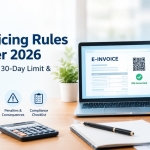




GST e-invoicing is mandatory in October 2026 for every GST-registered business whose aggregate annual turnover (AATO) has exceeded ₹5 crore in any financial year since FY 2017-18. These businesses must report B2B invoices, credit notes, debit notes and export invoices to the Invoice Registration Portal (IRP) to obtain an Invoice Reference Number (IRN) and a signed QR code. Businesses with an AATO of ₹10 crore or more must also report each document within 30 days of its date, or the IRP will reject it.
As of this update, the ₹5 crore threshold in force since 1 August 2023 remains unchanged. What has changed is enforcement: stricter IRP validations, mandatory multi-factor authentication and the hard 30-day reporting block mean that late or incorrect e-invoices now carry real cash-flow and input tax credit (ITC) consequences. This guide explains who must comply, the rules in force, how the process works, the penalties and a practical compliance checklist.
Chhota CFO helps businesses understand accounting, taxation and financial compliance requirements, including GST-related regulations.
Need Help Understanding GST E-Invoicing Rules?
Not sure whether your business needs to generate e-invoices? Get professional guidance on GST e-invoicing applicability, IRN generation and compliance requirements.
Contact Chhota CFO to understand your GST compliance needs.
Key takeaways
- Threshold: ₹5 crore AATO in any financial year from FY 2017-18 onwards (Notification No. 10/2023–Central Tax).
- Once in, always in: e-invoicing continues even if turnover later falls below ₹5 crore.
- PAN-level test: AATO is calculated across all GSTINs registered under the same PAN.
- 30-day rule: businesses with an AATO of ₹10 crore or more must report invoices to the IRP within 30 days of the invoice date (effective 1 April 2025).
- Covered documents: B2B invoices, credit notes, debit notes, exports and supplies to SEZs. B2C invoices are not covered.
- Consequence: an invoice without a valid IRN is not a valid tax invoice, which can block the buyer’s ITC and attract penalties.
Businesses should also stay updated on the latest GST compliance changes to manage reporting requirements and avoid common compliance errors.
What is GST e-invoicing?
GST e-invoicing is a system in which a business reports its B2B invoices and related documents in a standard electronic format (the e-invoice schema, Form GST INV-01) to a government-notified Invoice Registration Portal. The IRP validates the data, assigns a unique 64-character Invoice Reference Number (IRN) and returns the invoice with a digital signature and QR code. The invoice is still created in the supplier’s own billing or ERP software; e-invoicing does not mean the government generates the invoice.
Validated e-invoice data flows automatically to the supplier’s GSTR-1 and, where transport details are included, to the e-way bill system. This reduces manual reporting and reconciliation errors.
For a broader explanation of the process, read our complete guide to e-invoicing in India
Who must generate e-invoices in October 2026?
You must generate e-invoices if your business meets all of these conditions:
- You are registered under GST.
- Your AATO exceeded ₹5 crore in any financial year from FY 2017-18 to FY 2025-26.
- You do not fall into an exempt category (listed below).
A business that crosses ₹5 crore in a financial year must start e-invoicing from 1 April of the following financial year. For example, a business that first crossed ₹5 crore in FY 2025-26 has been required to e-invoice since 1 April 2026.
Businesses that are reviewing their registration details can also learn about common GST registration mistakes and how to correct them.
How is aggregate annual turnover calculated?
AATO is calculated at PAN level by combining the turnover of all GSTINs registered under the same PAN across India. Splitting operations across states or registrations does not reduce your AATO. Once the threshold has been crossed in any year, the obligation continues even if turnover falls below ₹5 crore in a later year.
Which transactions are covered?
- B2B supplies to GST-registered buyers, including tax invoices, credit notes and debit notes
- Exports of goods and services
- Supplies to SEZ units and developers, and deemed exports
B2C invoices issued to unregistered customers are outside the e-invoicing mandate. However, businesses with an AATO above ₹500 crore must print a dynamic QR code on their B2C invoices.
Who is exempt from e-invoicing?
These categories are exempt even if their turnover exceeds ₹5 crore:
- SEZ units (SEZ developers are not exempt)
- Insurance companies
- Banking companies and financial institutions, including NBFCs
- Goods transport agencies (GTAs) transporting goods by road
- Suppliers of passenger transportation services
- Suppliers of admission to cinema exhibitions in multiplex screens
- Government departments and local authorities
GST e-invoicing rules in force: summary table
The table below summarises the main e-invoicing rules that apply in October 2026.
|
Rule |
Applies to |
Effective from |
|
₹5 crore e-invoicing threshold |
AATO above ₹5 crore in any FY since 2017-18 |
1 August 2023 |
|
30-day IRP reporting limit |
AATO of ₹10 crore or more |
1 April 2025 |
|
Multi-factor authentication on IRP and e-way bill portals |
All taxpayers |
1 April 2025 (after a phased roll-out) |
|
24-hour IRN cancellation window |
All e-invoicing taxpayers |
Ongoing |
|
Fresh invoice number series |
All taxpayers |
Start of each FY (1 April 2026 for FY 2026-27) |
|
6-digit HSN codes on B2B invoices |
AATO above ₹5 crore |
1 April 2021 |
H2: The 30-day reporting rule explained
If your AATO is ₹10 crore or more, the IRP will not accept an invoice, credit note or debit note dated more than 30 days before the date of reporting. For example, an invoice dated 1 October 2026 must be reported by 31 October 2026. Once the window closes, no IRN can be generated and the document cannot become a valid e-invoice.
The 30-day block does not currently apply to businesses with an AATO between ₹5 crore and ₹10 crore. They should still report invoices promptly, because an invoice without an IRN is not valid.
Cancelling or correcting an e-invoice
An e-invoice can be cancelled on the IRP within 24 hours of generating the IRN; partial cancellation is not allowed. After 24 hours, correct errors by issuing a credit note or debit note, or by amending the details in GSTR-1.
How does the e-invoicing process work?
- Create the invoice in your billing or ERP software, with all mandatory fields of the e-invoice schema (INV-01).
- Generate the invoice data as a JSON file, or send it directly through an API or a GST Suvidha Provider (GSP).
- Upload the JSON to an authorised IRP, such as einvoice1.gst.gov.in.
- The IRP validates the data, checks for duplicates and generates the IRN, a hash of the supplier GSTIN, document number, document type and financial year.
- The IRP digitally signs the invoice and returns the signed JSON with the IRN, acknowledgement number and QR code.
- Print or embed the QR code on the invoice before sharing it with the buyer.
- The IRP passes the data to the GST portal to auto-populate GSTR-1 and, if transport details are included, to the e-way bill system.
API integration suits businesses with high invoice volumes. The offline utility or bulk upload tool suits businesses that issue e-invoices occasionally.
What are the penalties for not complying with e-invoicing?
Failing to generate a valid e-invoice affects both the supplier and the buyer:
- Invalid invoice: under Rule 48(5) of the CGST Rules, an invoice issued without following the e-invoicing process is not treated as a valid tax invoice.
- Loss of the buyer’s ITC: the buyer cannot claim input tax credit on an invalid invoice, which often leads to payment holds and disputes.
- Penalty for incorrect invoicing: Section 122 of the CGST Act provides a penalty of ₹10,000 or the amount of tax evaded, whichever is higher.
- General penalty: Section 125 provides a penalty of up to ₹25,000 for contraventions not covered elsewhere.
- Goods in transit: goods moving without a valid invoice and e-way bill can be detained under Section 129.
Avoid GST E-Invoicing Compliance Issues
Late reporting, incorrect invoice details and missing IRNs can create compliance challenges for your business. Make your invoicing process more reliable with the right accounting and GST compliance support.
Explore Chhota CFO’s Services for professional accounting and compliance assistance.
Common risk areas
- Invoices reported after the 30-day window (₹10 crore+ businesses)
- Schema mismatches and outdated HSN codes that cause IRP rejections
- Invoices sent to buyers before the IRN and QR code are generated
- Mismatches between IRNs generated, GSTR-1 and the books of account
- Missing signed JSON files and audit trails during assessments
E-invoicing compliance checklist
Use this checklist to set up or review your e-invoicing process:
- Check applicability: review AATO at PAN level for every year from FY 2017-18 onwards.
- Register on the IRP: enable e-invoicing and set up multi-factor authentication for all users.
- Choose the integration method: API or GSP integration for high volumes; the offline utility for low volumes.
- Update your ERP: confirm the latest schema version, 6-digit HSN codes and the new FY invoice series with your software vendor.
- Test before go-live: run sandbox tests covering rejections, IRP downtime, duplicate IRNs and QR code scanning.
- Block non-compliant dispatch: configure your system so invoices cannot reach buyers without an IRN.
- Track the 30-day window: run a daily ageing report of unreported invoices if your AATO is ₹10 crore or more.
- Train your team: make sure billing staff understand rejection codes, cancellation rules and escalation steps.
Best practices to stay audit-ready
- Store the IRN, acknowledgement number, acknowledgement date and signed JSON for every e-invoice for at least 72 months, the statutory record-retention period.
- Reconcile invoices issued, IRNs generated and GSTR-1 data at least once a week.
- Review IRP rejection logs daily and fix root causes, not just individual invoices.
- Follow GSTN advisories for schema, validation and portal changes.
- Check your GSP or software vendor’s service levels for downtime and fixes.
- Assign clear ownership of e-invoicing across finance and IT.
Why Choose Chhota CFO?
Chhota CFO provides practical financial and compliance support to help businesses manage their accounting, taxation and regulatory requirements with greater confidence. From business registrations to ongoing financial management, our services help entrepreneurs focus on growing their businesses.
- Expert Financial Guidance: Get support with accounting, taxation and financial planning for your business.
- GST and Tax Compliance: Manage GST registration, return filing and tax-related compliance
- Business Registration Support: Assistance with MSME registration, import-export registration and other business compliance needs.
- Reliable Accounting Services: Maintain organised financial records and improve visibility into your business finances.
- Business-Focused Solutions: Get services tailored to your business requirements and operational needs.
- Simplified Compliance Process: Make complex financial and regulatory tasks easier to understand and manage.
Conclusion
The e-invoicing rules in force in October 2026 are not new, but they are now strictly enforced. If your AATO has crossed ₹5 crore in any year since FY 2017-18, every B2B invoice needs a valid IRN and QR code. If your AATO is ₹10 crore or more, every document must also reach the IRP within 30 days.
The most reliable way to comply is to integrate your billing or ERP system with the IRP, stop invoices leaving without an IRN, and reconcile IRNs with your GST returns every week. Done well, e-invoicing reduces manual work, protects your customers’ ITC and keeps your business ready for audit.
Looking for Reliable GST Compliance Support?
Stay prepared for GST e-invoicing requirements with proper documentation, timely reporting and regular reconciliation. Chhota CFO can help your business manage its accounting and compliance requirements more efficiently.
Get in Touch with Chhota CFO to discuss your business requirements today.