


Most construction teams know the gap between the model and the site. They read one thing on the drawings and find another in the field. Crews reroute ducts, shift openings, and solve clashes on the spot. Within weeks, the BIM model no longer matches the building.
Closing that gap used to mean booking a laser scanning crew. Few projects can pay for that crew every Friday, so teams update the model only at milestones.
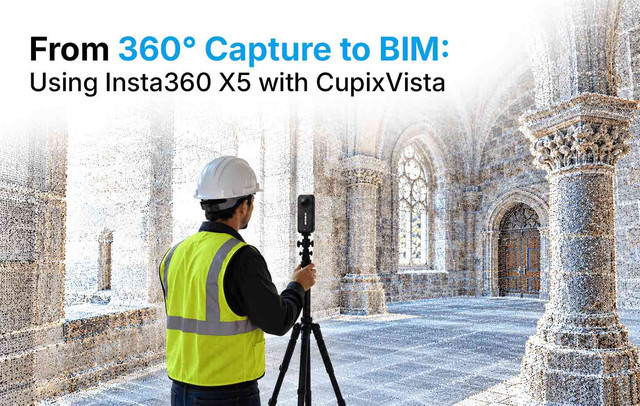
Field staff now have a faster reality capture to BIM option. They walk a floor with a 360° camera, and modelers receive usable geometry back. A popular pairing for this job is the Insta360 X5 camera with the CupixVista platform.
What Is 360° Reality Capture?
Practitioners have a formal name for that walk-through approach. 360° reality capture means recording a space with an omnidirectional camera while moving through it. Photogrammetry software then helps teams turn those video frames into a 3D model.
Surveyors using terrestrial laser scanning work from fixed tripod stations instead. Their results are very precise, but each scan day needs trained staff.
Teams using the camera method trade some precision for speed. Any superintendent can carry the camera, so capture can happen weekly or even daily. That frequency helps project teams with:
- Progress checks against the schedule
- Billing and pay application verification
- A dated visual record for construction site documentation and handover
With that rhythm in place, teams treat 3D Building Capture as a routine site habit. The quality of each capture, though, depends heavily on the camera.
Why Consider Insta360 X5 for AEC Documentation?
Modelers can only build from what operators capture. When operators record dim, noisy footage, modelers get gaps and soft edges. Older cameras built for 360° reality capture struggled in basements and MEP corridors.
Insta360 designed the X5 with larger sensors and an AI low-light mode called PureVideo. For field teams, three practical details matter most:
- Battery life: Insta360 rates the X5 at up to 185 minutes in Endurance Mode. Operators can cover long walks without pausing the reality capture workflow.
- Lenses: Insta360 made the lenses user-replaceable, so crews can swap a scratched one on site.
- Price: The camera launched at about $550, so a contractor can equip several superintendents.
With those details, contractors can roll the X5 out for construction site documentation across many projects. They still need software to turn that video into measurable space.
What Is CupixVista?
That software, in this pairing, is CupixVista. Cupix announced official Insta360 X5 support in July 2025. CupixVista is a cloud platform that lets teams upload 360° video and receive a 3D model and point cloud.
Cupix built its AI to work out camera positions, so users skip manual alignment. Teams using CupixVista for construction lean on a few features:
- Browser walkthroughs for remote reviewers
- Measurements taken directly in the 3D view
- Point cloud export in standard formats
How 360° Capture Supports BIM
Teams get value from a CupixVista point cloud only once they connect it to the design model. Without that link, VDC teams compare the model against redlined drawings and flat photos.
Contractors feel the cost of weak field data most in rework. In an Autodesk and FMI survey, respondents linked 48% of US rework to poor project data and miscommunication.
With a 360° capture, coordinators can overlay measured as-built conditions on the federated model. This helps them:
- Confirm installed work matches design locations before walls close
- Answer RFIs with a shared 3D view instead of a site trip
- Spot clashes between installed MEP and upcoming trades
Teams still need to respect accuracy limits. They should treat photogrammetry as a coordination tool and keep laser scanning for tight structural tolerances. Firms planning Point Cloud to BIM modeling should match each element to the method its tolerance needs. That decision also tells buyers of building documentation services what to put in a scope.
Combining 360° Capture with Scan to BIM
Matching methods to tolerances shapes how both fit into one project. Teams running a traditional Scan to BIM process start with a laser survey, then registration, then Revit modeling. Each step needs specialist time, so teams update the model only once or twice.
Teams can add 360° capture to that sequence as a frequent update layer. Surveyors set the precise baseline with laser scans, and field staff keep it current with camera walks. A typical field routine looks like this:
- Walk the zone at a steady pace with the X5 on a hardhat or pole
- Pause briefly at key junctions
- Finish at the starting point so processing can correct drift
- Upload to CupixVista and export the point cloud
Modelers then bring that point cloud into Revit and trace as-built conditions. This mix keeps Point Cloud to BIM work current between laser surveys. On renovation jobs, a defined Scan to BIM workflow also sets accuracy targets before anyone captures data.
The Future of Reality Capture in AEC
Weekly data already helps, but most teams still review it by hand. Software vendors are working on automated comparisons between fresh captures and the BIM model. If those tools mature, superintendents could catch a misplaced sleeve before the trade leaves.
Owners are also asking for more at handover. With dated 3D Building Capture records behind a digital twin, facility teams can trust what they inherit. Providers of building documentation services who build a steady reality capture workflow now will meet those requests more easily.
Conclusion
Teams close the gap between model and site by capturing frequently and feeding that data back into BIM. With the Insta360 X5, field staff get a durable camera that holds up in dim spaces. Contractors using CupixVista for construction can then turn that footage into point clouds modelers trust.
For daily coordination and progress checks, contractors can now run reality capture to BIM on every project. Firms that decide early which elements need which method will get more from every Scan to BIM workflow.