


Strut channels supplied by DIC Fasteners are used in industrial and mechanical support systems for pipes, cables, HVAC equipment, solar structures, and other installations.
The two main types are Slotted Strut Channels, which feature pre-punched slots for easier adjustment, and Solid Strut Channels, which have a continuous surface for custom drilling.
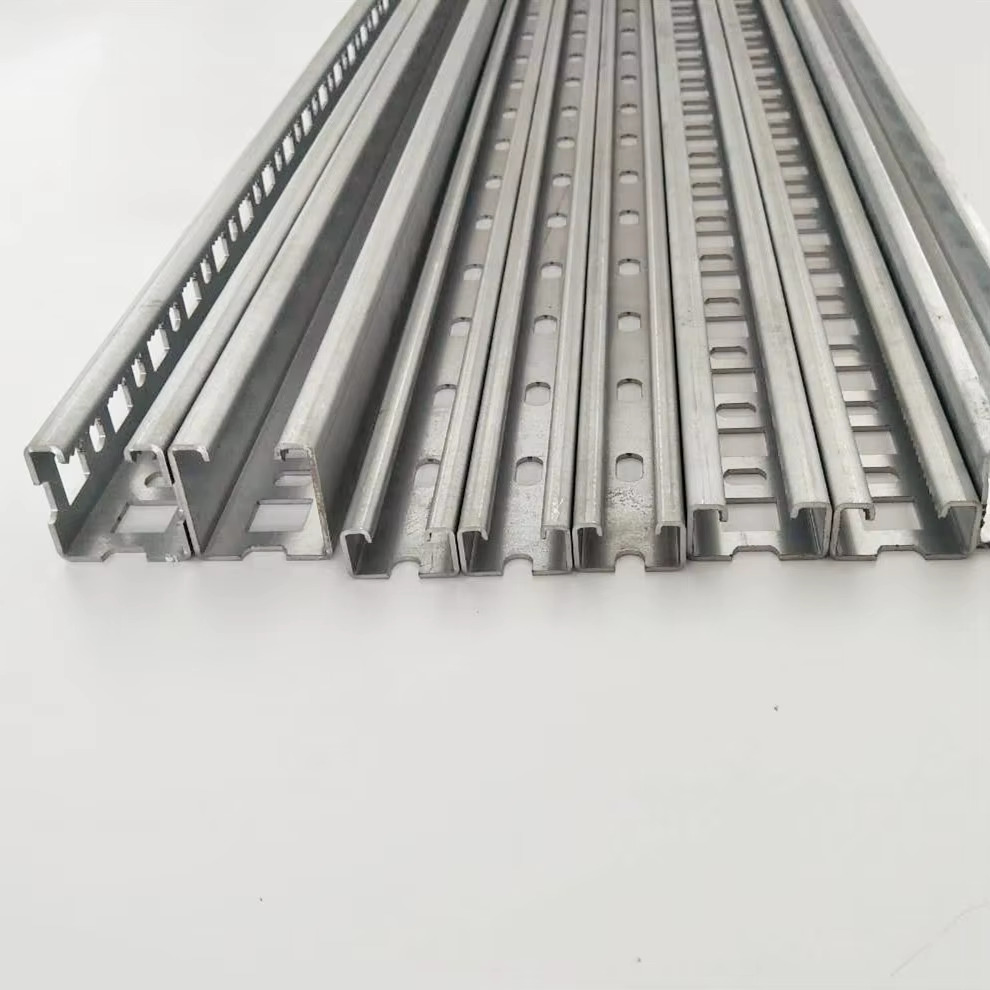
The right choice depends on installation speed, adjustability, load requirements, connection methods, and project specifications. Both types are available in different sizes, materials, thicknesses, and finishes to suit various industrial and commercial support applications.
What Is a Slotted Strut Channel?
A Slotted Strut Channel is a metal support channel manufactured with regularly spaced slots along its length. These openings allow bolts, nuts, brackets, clamps, and other channel accessories to be positioned and adjusted without drilling additional holes in many installations.
Slotted channels are particularly useful where frequent adjustment or flexible component positioning is required. Their pre-punched openings can reduce installation time and make them suitable for modular support frameworks.
Key Features of Slotted Strut Channels
- Pre-punched slots for easier fastening
- Adjustable connection points
- Compatible with various strut channel accessories
- Suitable for modular support systems
- Available in different sizes, thicknesses, and finishes
- Useful for installations requiring frequent adjustments
What Is a Solid Strut Channel?
A Solid Strut Channel has a continuous surface without factory-punched slots. This configuration provides a uniform channel profile and allows holes to be drilled at specific locations according to project requirements.
Solid channels are often selected when customized hole positioning, additional structural continuity, or specific fabrication requirements are important.
Key Features of Solid Strut Channels
- Continuous channel surface
- Flexible for custom drilling and fabrication
- Suitable for heavy-duty support frameworks
- Clean and uniform appearance
- Available in different materials and finishes
- Useful for applications requiring precise connection locations
Slotted Strut Channel vs Solid Strut Channel
The primary difference between these two channel types is the presence of pre-punched slots.
A slotted channel offers greater installation flexibility because fasteners can be positioned through existing slots. This can simplify assembly and adjustment during installation.
A solid channel provides a continuous surface, making it suitable where connection points need to be drilled according to exact project requirements. It can also be preferred for certain fabricated or customized support structures.
For projects involving repetitive installations and adjustable support components, slotted channels can provide significant installation convenience. For customized fabrication and applications where predetermined slot locations are unsuitable, solid channels may offer greater flexibility.
Technical Comparison
|
Parameter |
Slotted Strut Channel |
Solid Strut Channel |
|
Channel Surface |
Pre-punched slots |
Continuous surface |
|
Installation |
Fast and adjustable |
Requires drilling where needed |
|
Connection Flexibility |
High |
High after customization |
|
Field Modification |
Generally easier for standard connections |
Suitable for custom hole locations |
|
Accessories |
Compatible with standard strut accessories |
Compatible with strut accessories |
|
Fabrication |
Less drilling required |
More fabrication may be required |
|
Applications |
Cable supports, HVAC, electrical and pipe systems |
Custom frames, heavy-duty supports and fabricated structures |
|
Finish Options |
Galvanized, zinc-plated and other options |
Galvanized, zinc-plated and other options |
|
Customization |
Available in different sizes and slot patterns |
Highly adaptable through custom drilling |
|
Installation Time |
Often lower for standard assemblies |
May be higher where drilling is required |
Industrial Applications
Both slotted and solid strut channels are used across multiple industrial sectors. The appropriate type depends on the support design, installation method, and structural requirements.
Cable Tray and Electrical Support
Slotted strut channels are commonly used for supporting cable trays, conduits, electrical panels, and wiring systems. The slots allow support components to be positioned and adjusted efficiently.
HVAC Installations
Strut channels can support ducts, pipes, air-handling components, and other HVAC equipment. Slotted channels can be particularly useful when support locations need adjustment during installation.
Pipe Support Systems
Both channel types can be used for pipe racks and pipe support assemblies. Channel size, material thickness, connection design, and load requirements should be considered when selecting the appropriate configuration.
Solar Structures
Strut channels are used in various solar mounting and support frameworks. Slotted channels can simplify alignment and positioning of components during installation.
Mechanical and Industrial Assemblies
Manufacturing plants and engineering facilities use strut channels for equipment supports, frames, brackets, service platforms, and modular mechanical assemblies.
Construction and Fabrication
Contractors and fabricators use strut channels to create adjustable support frameworks without requiring extensive welding for every connection.
Benefits of Slotted Strut Channels
- Faster Installation
- Easy Adjustment
- Modular Construction
- Reduced Fabrication Work
Benefits of Solid Strut Channels
- Customized Hole Positioning
- Continuous Surface
- Fabrication Flexibility
- Suitable for Customized Frameworks
How to Choose the Right Strut Channel
The selection of a strut channel should be based on more than whether it is slotted or solid. Engineers and buyers should consider the following factors:
- Required load capacity
- Channel dimensions
- Material grade
- Channel thickness
- Corrosion protection
- Slot size and spacing
- Connection method
- Installation environment
- Required customization
- Project-specific engineering requirements
For standard adjustable installations, a slotted strut channel can be a practical choice. For customized fabrication where connection points need to be drilled according to specific requirements, a solid strut channel may be more suitable.
The final selection should always consider the actual structural load, span, support arrangement, fastening system, installation conditions, and applicable project specifications.
About DIC Fasteners
DIC Fasteners is a trusted Strut Channel Manufacturer and Supplier in India, offering quality fastening and support solutions for industrial, construction, engineering, fabrication, and commercial applications. With a focus on reliable products, dimensional accuracy, and customer-specific requirements, we serve OEMs, distributors, contractors, wholesalers, and industrial buyers.
Our Products
Our product range includes Threaded Rods, Strut Channels, Industrial Nuts, Bolts, Washers, Screws, Rivets, Brass Fasteners, Industrial Pins, and other industrial fasteners. We offer standard as well as customized solutions based on application, dimensions, material, finish, and project requirements.
International Markets
DIC Fasteners supplies industrial fastening solutions to customers across USA, Canada, UK, Germany, UAE, Oman, Kuwait, Qatar, Australia, France, Italy, Netherlands, Belgium, Spain, Poland and other international markets.
Frequently Asked Questions
- What is the main difference between slotted and solid strut channels?
The main difference is that slotted strut channels have factory-punched openings, while solid strut channels have a continuous surface that can be drilled according to installation requirements.
- Which strut channel is easier to install?
Slotted strut channels are generally easier for standard installations because their pre-punched slots can reduce drilling and provide adjustable connection points.
- Are solid strut channels suitable for heavy-duty applications?
Yes, solid strut channels can be used for heavy-duty applications when the channel dimensions, material, thickness, span, and support design are appropriately selected for the required load.
- Can slotted strut channels be customized?
Yes. Slotted strut channels can be supplied in different dimensions, materials, finishes, and slot configurations depending on manufacturer capabilities and project requirements.
- Which is better for cable tray support?
Slotted strut channels are commonly preferred for cable tray support where adjustable positioning and faster installation are beneficial. However, the final selection should be based on the actual load and support design.
- Can strut channels be used for HVAC systems?
Yes. Strut channels are widely used for supporting HVAC ducts, pipes, equipment, and related mechanical components.
Contact DIC Fasteners
Looking for reliable Strut Channels or industrial fasteners? Contact DIC Fasteners today for quality products, customized requirements, and dependable supply.