
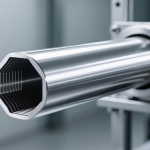
In the world of industrial manufacturing, precision is not just a goal—it is a fundamental requirement. This is especially true for components used in critical systems like heat exchangers and automotive assemblies. The process of creating aluminum drawn profiles and tubes is a perfect showcase of engineering precision meeting practical application.
The journey begins with aluminum alloy billets, which are first extruded to form a basic shape. The true magic, however, happens in the cold drawing process. Here, the extruded aluminum is pulled (or drawn) through a precision die at room temperature. This action reduces its diameter, refines its grain structure, and imparts exceptional dimensional accuracy and a superior surface finish. Whether producing a standard round aluminum drawn tube or a complex custom aluminum drawn profile, this method ensures "high precision and tight tolerances," as highlighted by manufacturers.
This level of precision is what enables the production of specialized components like the aluminum inner grooved tube. Creating consistent, microscopic internal grooves with heights as small as 0.05mm would be impossible without the foundational accuracy provided by the cold drawing process. The synergy is clear: the cold drawing process provides the dimensional perfection, which then allows for advanced secondary processing to create enhanced features.
From the smooth, consistent bore of a round aluminum drawn tube used in a solar thermal system to the intricate cross-section of a custom spacer bar profile for a plate-and-bar heat exchanger, cold drawing is the unsung hero. It transforms raw aluminum into reliable, high-performance components that form the backbone of efficient machinery and systems worldwide.