

Nobody enjoys getting the letter. A DCAA audit notice lands in your inbox, and suddenly the whole finance team is digging through old files. The contractors who handle this well don't panic. They prepared months earlier, so the audit becomes a routine task instead of a crisis.
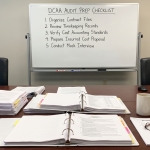
This checklist walks through the steps that matter most. Some take an afternoon. Others take a few weeks to set up. Together, they put your company in a strong position for any DCAA audit, whether it's a pre-award survey or an incurred cost review.
Step 1: Know which DCAA audit you're facing
Start by reading the notice carefully. Each type of DCAA audit has its own focus.
A pre-award accounting system survey checks whether your system can handle a cost-type contract. A proposal audit tests the numbers in a bid. An incurred cost audit compares the indirect rates you actually incurred against what you billed. A floor check verifies employee timekeeping on the spot. Knowing the type tells you which records the auditor will want and which risks to focus on.
If anything in the notice is unclear, ask. Auditors would rather answer a question at the start than chase missing documents later.
Step 2: Name a single point of contact
Pick one person to manage the DCAA audit. This person schedules meetings, tracks document requests, and makes sure every answer is accurate and consistent.
Without a single contact, requests get lost and different staff members give different answers. That confusion can raise red flags even when your records are fine. A clear owner keeps the DCAA audit organized and shows the auditor you take compliance seriously.
Step 3: Put your policies in writing
Auditors don't just look at numbers. They look at how you produce them. A DCAA audit will often begin with a request for your written policies and procedures.
At a minimum, you should have documented policies for:
- Timekeeping, including daily entry, corrections, and supervisor approval
- Separating direct and indirect costs
- Allocating indirect costs to contracts using a consistent base
- Identifying and segregating unallowable costs
- Billing the government and reconciling invoices to the books
- Purchasing and approving expenses
- Record retention and document storage
Written policies need to match what your team actually does. An auditor will test that. If your policy says employees enter time daily but half of them fill timesheets on Friday, the DCAA audit will find it.
Step 4: Review your chart of accounts
Your chart of accounts is the backbone of a clean DCAA audit. It should make it easy to tell direct costs from indirect costs and to see which contract each direct cost belongs to.
Check that you have separate accounts for unallowable costs. Items like entertainment, alcohol, gifts, lobbying, and most fines and penalties should never sit in an account that feeds an indirect rate. If they do, those costs can end up on a government invoice, and the auditor will question them.
Also confirm that your indirect cost pools are set up clearly. Most contractors use some version of fringe, overhead, and general and administrative (G&A) pools. Each pool needs a logical allocation base, and you need to apply it the same way every period.
Step 5: Test your timekeeping
Labor is usually the largest cost on a government contract. That makes timekeeping one of the most closely watched areas in any DCAA audit.
Pull a sample of timesheets and check them yourself. Did employees record their own time? Did they enter it daily? Are corrections documented with a reason and an approval? Do supervisors sign off? Does every hour worked appear on the timesheet, including hours over 40?
Then do a mini floor check. Walk around and ask a few employees what they're working on. Compare their answers to their timesheets for that day. If the answers don't match, fix the training gap before a real auditor finds it during the DCAA audit.
Step 6: Reconcile your books
Auditors expect your records to tie together. Your labor costs should match payroll. Your job cost ledger should tie to the general ledger. Your invoices should match recorded costs. If numbers don't reconcile, a DCAA audit will slow down while you explain the difference.
Make reconciliation a monthly habit. Waiting until year-end makes errors harder to trace and easier to miss. Monthly reviews also let you catch mispostings, such as a direct cost charged to the wrong contract, while the details are still fresh.
Step 7: Gather supporting documents
Every cost needs proof. In a DCAA audit, the auditor may pick a sample of transactions and ask for the full trail behind each one.
That trail usually includes the invoice or receipt, the purchase approval, evidence of payment, and the account the cost was posted to. For travel, you'll need trip purpose and itemized receipts. For subcontracts, you'll need the agreement and the invoices. For consultants, you'll need a contract and some proof of the work performed.
Store these documents so you can find them quickly. A shared drive with a clear folder structure works fine for many small businesses. The goal is to answer a DCAA audit request in hours, not weeks.
Step 8: Check your indirect rates
For incurred cost and proposal audits, your indirect rates get extra attention. Calculate your actual rates for the period and compare them with the provisional rates you used for billing.
If your actual rates came in higher, you may be able to recover more money. If they came in lower, you may owe the government a refund. Either way, you want to know the answer before the DCAA audit does. Review the costs in each pool, remove anything unallowable, and make sure the allocation base is complete.
Watch your deadlines as well. Contractors with cost-type contracts generally must submit an incurred cost proposal within six months after the end of each fiscal year. A late or incomplete submission can trigger extra questions and a longer DCAA audit. Put the due date on the calendar and start gathering numbers well before it arrives.
Step 9: Run an internal mock audit
One of the best ways to prepare for a DCAA audit is to stage one yourself. Ask someone outside the day-to-day accounting work to review your records with fresh eyes.
Have them pull random transactions, trace them to documents, and test a few timesheets. They should also read your policies and confirm that practice matches paper. Keep notes on every gap you find, assign an owner to fix it, and set a deadline.
Some contractors bring in an outside accounting firm for this step. An expert who has seen many audits knows where problems usually hide.
Step 10: Prepare your team for the auditor
Staff members may be interviewed during a DCAA audit. That can be stressful if they don't know what to expect.
Brief them in advance. Explain what the auditor is checking and why. Encourage them to answer questions honestly and simply. If they don't know an answer, they should say so and refer the auditor to the point of contact. Nobody should guess, and nobody should volunteer opinions about things outside their role.
Step 11: Manage the entrance and exit conferences
The entrance conference sets the tone for the DCAA audit. Use it to confirm the scope, timeline, and document list. Agree on how you'll deliver records and how often you'll check in.
The exit conference is your chance to respond to preliminary findings. Come prepared. If the auditor questions a cost, provide extra support or explain your reasoning. Clear, factual responses at this stage can resolve issues before they appear in the final report.
Step 12: Follow up after the DCAA audit
Your work isn't done when the auditor leaves. Read the final report carefully. If it identifies deficiencies, create a written plan to fix them and track your progress.
Use the results to improve. A finding in one DCAA audit often points to a weakness that will show up again in the next. Fixing it now saves time, money, and stress later.
Conclusion
A DCAA audit goes smoothly when the groundwork is already in place. Written policies, a clean chart of accounts, accurate timekeeping, monthly reconciliations, and organized documents make up most of that groundwork. Add a mock audit and a prepared team, and you're ready for whatever the notice asks.
Diener & Associates is a CPA firm that helps government contractors prepare for every type of DCAA audit. The firm has managed hundreds of audits and works with contractors in Northern Virginia and nationwide to set up compliant accounting systems, review records, and respond to auditor findings. To get your company ready before the next notice arrives, explore DCAA compliance services from Diener & Associates.