
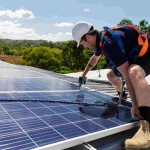

Solar power Perth WA is becoming an important consideration for homeowners looking to generate renewable electricity, manage household energy consumption and make better use of Perth’s abundant sunshine. A well-designed solar system can combine high-quality panels, an efficient inverter and, where appropriate, a battery to help households use more of their own generated electricity.
For homeowners researching Perth solar power, choosing the right system involves more than simply comparing the number of panels or the advertised installation price. System size, roof orientation, household electricity consumption, battery requirements, inverter technology, available incentives and local grid requirements should all be considered before making a decision.
Why Solar Energy Makes Sense for Perth Homes
Perth receives substantial sunshine throughout the year, creating favourable conditions for rooftop solar generation. Solar panels convert sunlight into direct-current electricity, while an inverter converts that electricity into usable alternating-current power for household appliances.
During the day, solar generation can help supply common household loads such as refrigeration, air conditioning, washing machines, lighting and home office equipment. When solar production exceeds immediate household demand, surplus electricity may be exported to the grid or stored in a battery, depending on the system configuration.
The value of solar is therefore closely connected to how a household uses electricity. Families that consume more electricity during daylight hours may directly use a larger share of their solar generation, while households with significant evening consumption may consider battery storage.
Understanding Solar Panels and System Size
The panels are one of the most visible components of a rooftop solar installation, but they are only part of the overall system. A professional design should consider available roof space, shading, roof orientation, panel efficiency, expected energy consumption and the inverter capacity.
Common residential systems can be designed around household requirements rather than using a one-size-fits-all approach. A smaller household may have different electricity requirements from a large family with several air conditioners, pool equipment, electric appliances or an EV.
When comparing panels, homeowners may encounter famous brand names such as SunPower, REC, JinkoSolar, Trina Solar, LONGi and Canadian Solar. Brand recognition can be useful, but product specifications, warranty conditions, certification, installer experience and suitability for the local installation are also important considerations.
The Role of the Solar Inverter
The inverter is another critical component of a rooftop solar system. It converts electricity generated by the panels into a form that household appliances can use. In systems incorporating battery storage, a suitable hybrid inverter may coordinate solar generation, battery charging, household consumption and grid interaction.
Popular inverter brands in the Australian market include Fronius, Sungrow, GoodWe, SolarEdge and Sigenergy. Each technology has different features, operating characteristics and system compatibility considerations.
Homeowners should also pay attention to current Western Australian technical requirements. Since 1 May 2026, new and upgraded solar PV and battery systems on the South West Interconnected System have needed to support modern grid communication standards. New or upgraded systems also need to meet applicable inverter and emergency-management requirements.
This makes professional system design and compliant installation particularly important.
Adding a Battery to Perth Solar Power
A battery can change the way a household uses solar energy. Instead of exporting all excess daytime generation, a battery can store some of that electricity for later use, such as during the evening when household demand may increase.
Battery storage can be particularly useful for homes with substantial evening electricity consumption. It can also complement solar panels by increasing the amount of generated electricity that is consumed within the property.
Western Australia currently has a Residential Battery Scheme providing support for eligible households. The WA Government states that eligible Synergy customers can receive up to $1,300, while eligible Horizon Power customers can receive up to $3,800 under the state scheme, subject to the program's requirements. The scheme also operates alongside the Federal Government's Cheaper Home Batteries Program.
Eligibility conditions matter. The WA scheme requires eligible batteries, approved equipment and participation in a Virtual Power Plant arrangement. The government also states that solar-only installations do not qualify for the battery rebate, although new or upgraded solar panels may be eligible for loan funding when installed as part of a battery package.
Because rebate programs and eligibility requirements can change, homeowners should verify current conditions before signing a contract.
Solar Power and Electric Vehicles
The growth of EV ownership is also influencing household energy planning. An electric vehicle can significantly increase electricity consumption, particularly when it is charged frequently at home.
Combining solar panels with an EV charger can allow homeowners to use daytime solar generation for vehicle charging where household schedules permit. A suitable energy-management strategy can coordinate household loads, solar production, battery storage and EV charging.
It is important to understand that an EV itself is not currently eligible for the WA Residential Battery Scheme. The WA Government specifically states that EVs are not included in the scheme, even though some vehicle-to-grid technologies can potentially allow an EV to interact with the electricity grid.
Choosing a Solar System for Your Home
A practical solar assessment should begin with your electricity usage rather than simply selecting the largest available system. Review recent electricity bills and consider when your household consumes the most energy.
Important factors include:
- Average daily electricity consumption
- Daytime versus evening energy use
- Roof size and orientation
- Shading from trees or surrounding buildings
- Panel technology and warranty
- Inverter capacity and functionality
- Battery storage requirements
- EV charging needs
- Future household electricity demand
- Grid connection requirements
- Available rebates or financing options
A household with high evening consumption may place greater value on battery storage, while a household that uses significant electricity during daylight hours may benefit from prioritising appropriately sized solar generation.
Solar in Perth's Diverse Suburbs
Solar requirements can vary between homes across Perth because properties differ in age, roof design, orientation, available space and electricity usage. Homeowners researching Perth solar power may be located in areas such as East Perth, West Perth, Subiaco, Victoria Park, Bayswater, Belmont, Bentley, Cannington, Carlisle, Kewdale, Redcliffe, Queens Park, Dianella, Balcatta, Osborne Park, Tuart Hill, Joondanna, Glendalough, Nollamara, Embleton, Churchlands, Floreat, Nedlands, Dalkeith, Shenton Park, Claremont and surrounding suburbs.
Older homes may require additional electrical assessment, while newer properties may already have electrical infrastructure suitable for modern energy systems. Properties with limited roof space may need higher-efficiency panels, whereas larger roofs can provide greater flexibility in system design.
Getting the Most From Your Solar Investment
The performance of solar power Perth WA systems depends on both equipment and everyday energy management. Running suitable appliances during periods of strong solar generation can increase self-consumption. Smart scheduling can also help households coordinate washing machines, dishwashers, pool pumps, hot-water systems and EV charging with solar production.
For homes with batteries, intelligent charging and discharge settings can further improve energy management. However, battery sizing should be based on actual electricity consumption rather than simply choosing the largest available storage capacity.
It is equally important to compare complete installation proposals rather than focusing only on the headline price. A quote should clearly explain the panel model, inverter, battery capacity if applicable, mounting equipment, warranties, installation scope, monitoring system and grid connection requirements.
Final Thoughts
Solar power Perth WA offers homeowners an opportunity to generate renewable electricity and potentially reduce reliance on grid-supplied energy. The most suitable system depends on individual electricity consumption, roof characteristics, equipment selection, battery requirements and future energy plans.
For anyone considering Perth solar power, the best starting point is a detailed assessment of current electricity usage followed by a system design that considers panels, inverter technology, battery storage, EV charging and applicable government support. With changing grid requirements and battery incentives, choosing compliant equipment and an experienced installer is an important part of creating a reliable long-term home energy solution.
Location:- Perth, Western Australia
https://en.wikipedia.org/wiki/Perth
https://arena.gov.au/renewable-energy/solar/
https://www.wa.gov.au/government/wa-residential-battery-scheme-information-applicants